
I Miss Blu
The Italian muralist was a political cartoonist that changed the way public space could be looked at

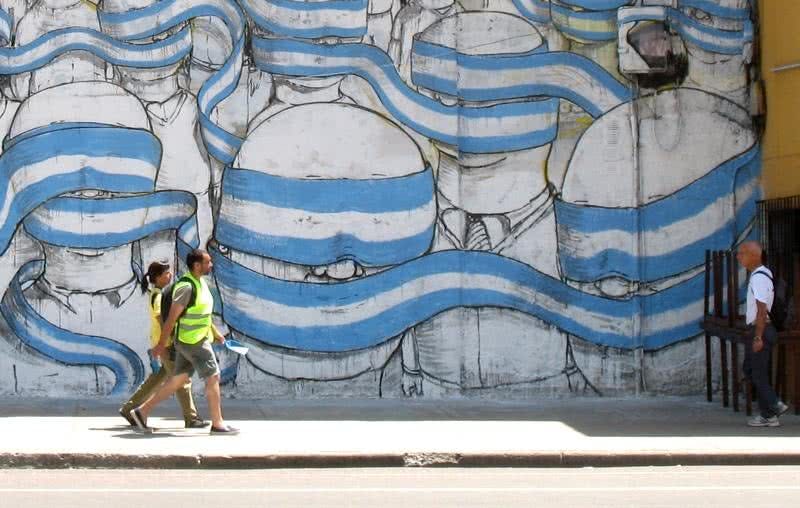
In the wee hours of a late September morning in 2011, a colleague and I drove into the small city of Grottaglie, Italy, after an all-night ride from Rome. We couldn’t quite figure out where our hotel was. The city has a unique landscape: it’s surrounded by ravines, so it appears higher in elevation than it really is, and it winds around in different directions, making it hard to decipher what’s the center and what’s the edge. The first thing I remember seeing was a mural by Italian street artist Blu, as soon as we crossed into the city. Given that we were there for FAME Festival, perhaps one of the more renegade art festivals in the world at that point, spotting Blu meant we were in the right place.
It felt almost mischievous, even a little dangerous, to be driving from Rome to the south of Italy in the middle of the night after a flight from San Francisco, and for some reason, seeing a Blu piece as the sort of “x marks the spot” moment on the drive felt spot on: Blu was representative of a mischievous, vital, anarchic, punk, political moment in street art that was more bound by a lack of infrastructure than by anything else, and more driven by passion of purpose. The vibe felt like DIY meets revolution. Art should be put into daily life, not as tags, but as modern murals that spoke to a collective consciousness but also didn’t ask permission. It was righteous and, at times, really fucking right. To this day, I think that is what made street art so powerful in that window of 2000–2008; by the time I arrived in Grottaglie in 2011, Banksy was already a global icon, Shepard Fairey was a presidential artist, and Swoon was invading the Venice Biennale. I was almost there as an observer of what once was, and FAME Festival was one of the last bastions of authenticity of a movement that was slowly becoming a real estate aesthetic for badly designed condos with a boba tea shop on the ground floor.
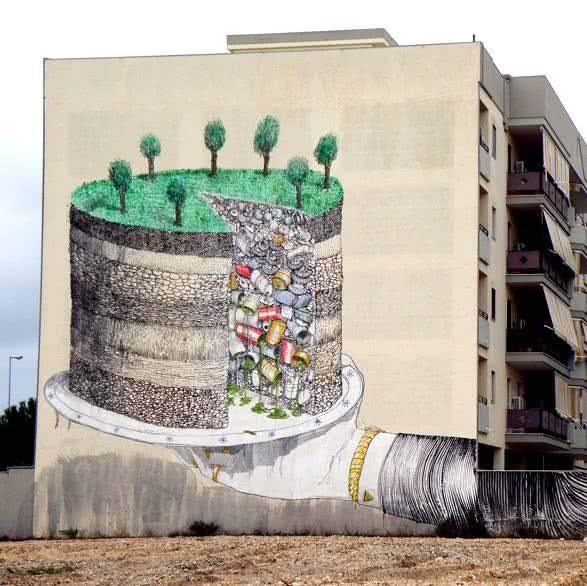
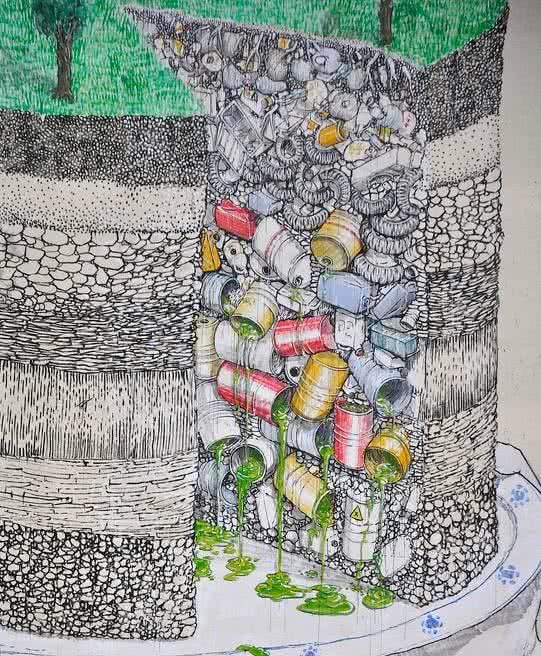
Blu was, and has always been, different. He was a renegade making murals that read more like political cartoons. He was a pioneer of stop-motion animation, creating a series of videos that culminated in the groundbreaking COMBO work he made with David Ellis for FAME in 2009. I think most of us who were involved in the street art universe could probably tell you that this video was sort of the mic drop of the movement. It was never going to be the same after that, because the raw and original spirit of the thing could not be replicated. And of course, the murals. They questioned power and felt authoritative simply by being so large. Even if you didn’t know the particular political characters he was talking about or critiquing, you understood the universality of challenging power structures and the powerful people who dictate our lives. Though some of Blu’s murals are explicitly political, it’d be an oversimplification to say his whole body of work is defined by politics; a lot of it is more about power, consumerism, war, religion, and social control in broader terms, using recurring motifs rather than direct commentary on specific parties or leaders. Hence the universality.
The murals also, at least to me, spoke about the impending assault of technology. There were countless visual metaphors and transformations — figures built from repeating human bodies, machinery growing out of people, cranes and oil pumps as puppet masters — to comment on themes of war, capitalism, surveillance, and environmental destruction.
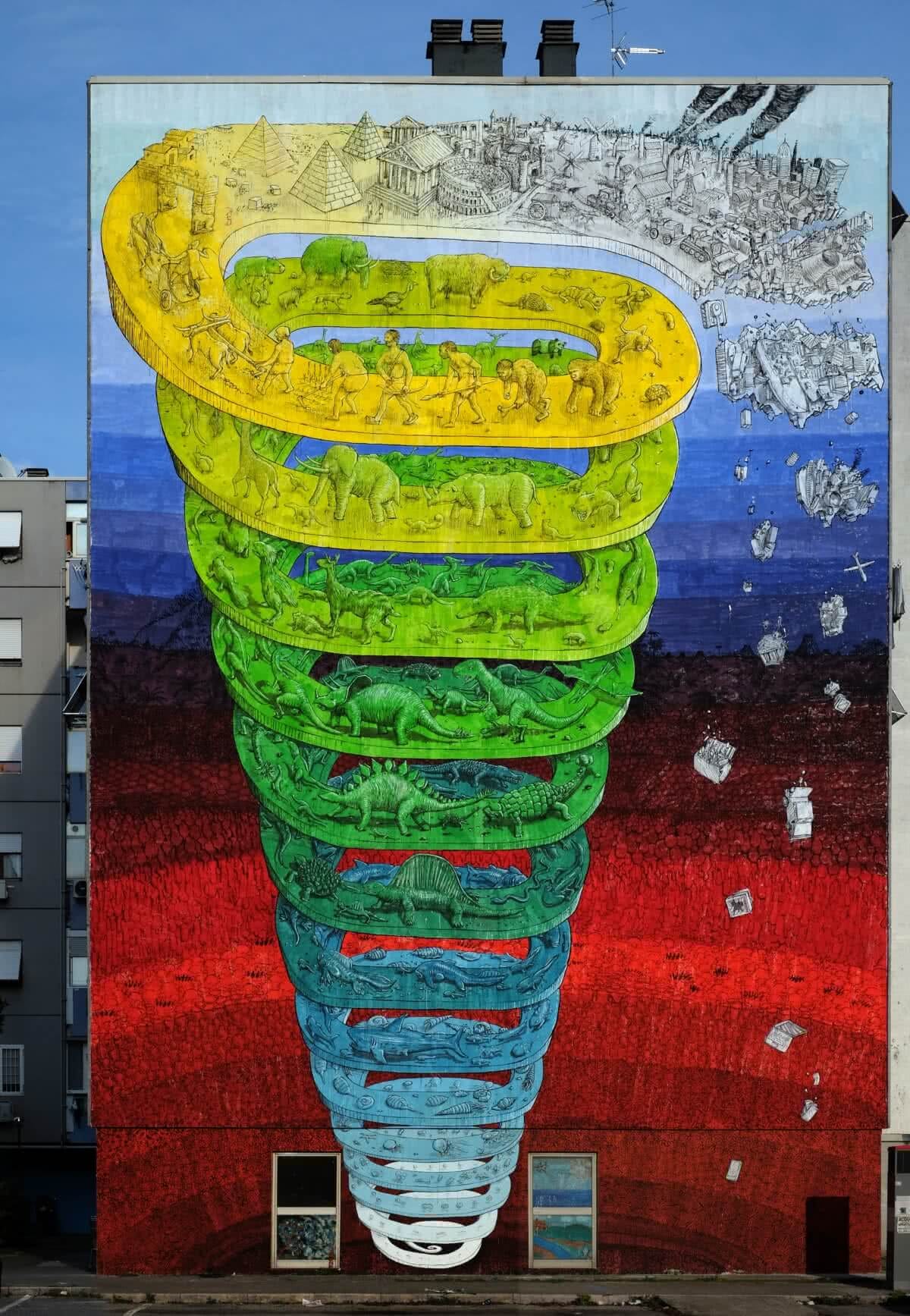
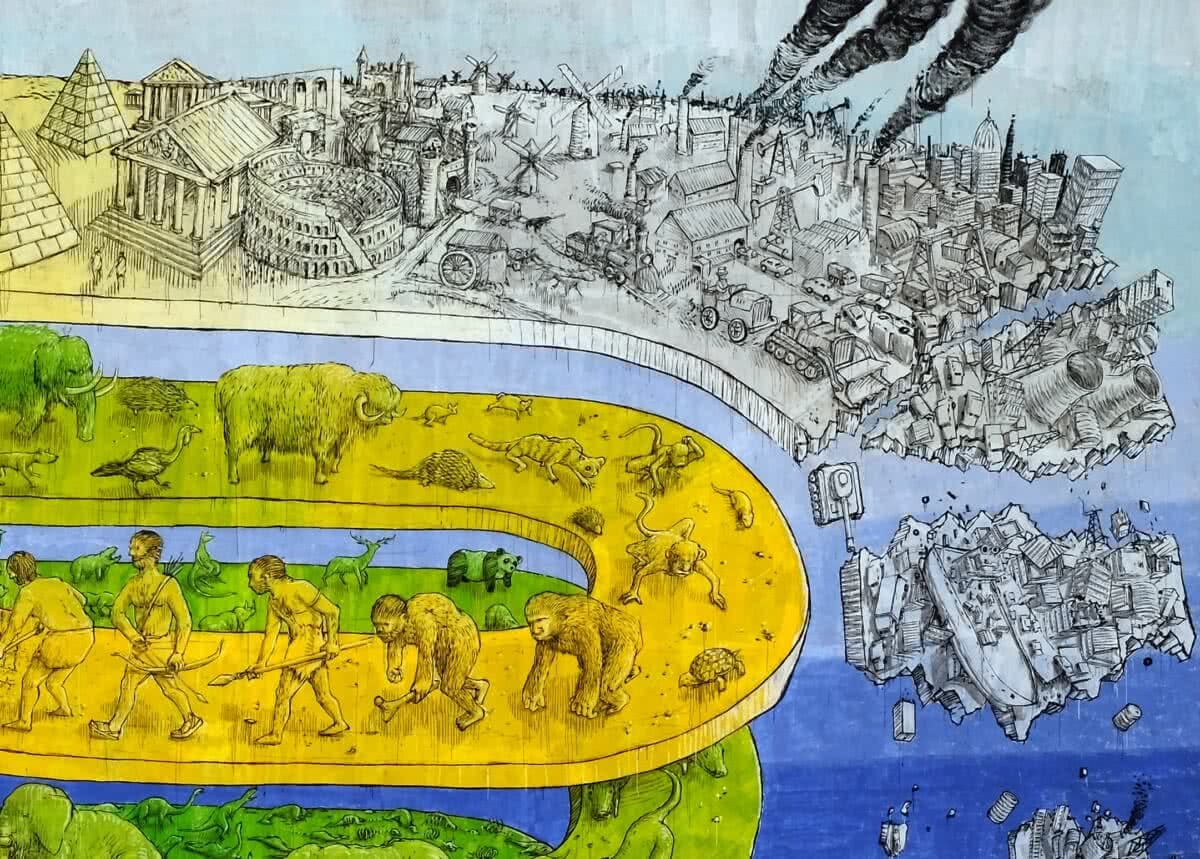
And then, of course, one of his most famous political acts wasn’t a mural but an erasure: in 2016, he painted over years of his own work in Bologna in protest of a planned exhibition that would have displayed street art (including some of his) removed from walls and shown in a museum without artists’ consent, in what he saw as institutional appropriation of a form meant to stay public and free. This was an actual fuck you to power, a fuck you to consumerism, a fuck you to the over-organization of art, and the stupefying need to contain what was meant to be uncontained. Most artists wouldn’t erase years of their own work from existence, but the principle was set. (Of course, there was the MOCA “Art in the Streets” moment, where his work was buffed after an incredible mural that featured a scene of rows of coffins draped in one-dollar bills — an antiwar image — on the side of the Geffen Contemporary. The organizers were concerned that the image would provoke protest from the L.A. Veterans Affairs hospital nearby. He didn’t erase this one on his own; it was a forced removal.)
What I am getting at is that I miss Blu, I miss this spirit, and in a moment in time when the art world seems in flux — when uber-consumerism, uber-capitalism, and social media marketing have laid to ruin a lot of arts organizations and support for emerging art — we could use someone with the gall to ask how to speak truth to power in public spaces. There are so many artists doing an incredible version of this within the institutional system — the great voices of rafa esparza, Nick Cave, Kara Walker, Guerrilla Girls, just to name a few. But what Blu had in his aesthetic was comic books and cartoons. It was in the great tradition of Herbert Block, yet building-sized. It was in public, it was free to see, and it was of an opinion but also of the human condition. I have said this so much in my writing recently and in conversations with friends and colleagues who do care about art in public, most of the words and images we see in public space today are telling you what to do: go here, follow this, buy stuff, obey things, sell, sell, sell, stop! Blu was making images that made you wonder where we were all going, who we were following, how we were following, and why we had become so powerless to stop it.
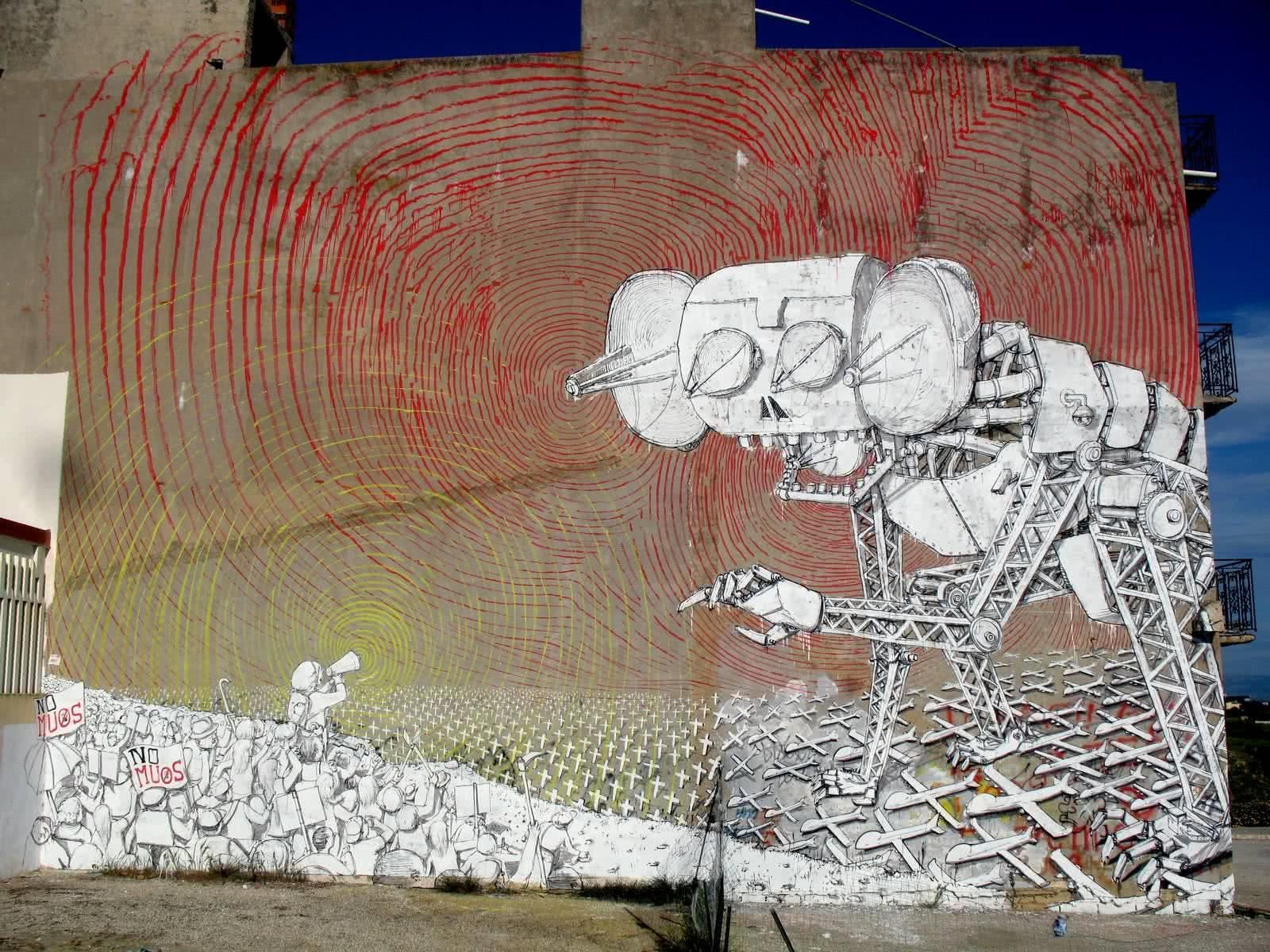
What a shame it was that “curators” thought it was necessary to preserve his work, meant for the street, in some institutional setting. It took the life out of the work. It took the message away. It took away the audacity of leaving something for people to discover. I think this ultimately killed Blu’s passion to participate in public space. I know he is active every so often, but that spirit of punk was stolen from him.
This isn’t a nostalgic take, more of an opportunity to think about how much of our discourse around art is about the market and not the content, and how, when we had someone actively pursuing something outside the system, some organizers tried to drag him in anyway. But I still hold that memory of being lost in an Italian city and seeing a Blu and knowing I was right where I wanted to be… still lost, but with a little direction…
Text by Evan Pricco // All images from Blu’s website.
Read and subscribe to The Unibrow journal here: https://the-unibrow.com